
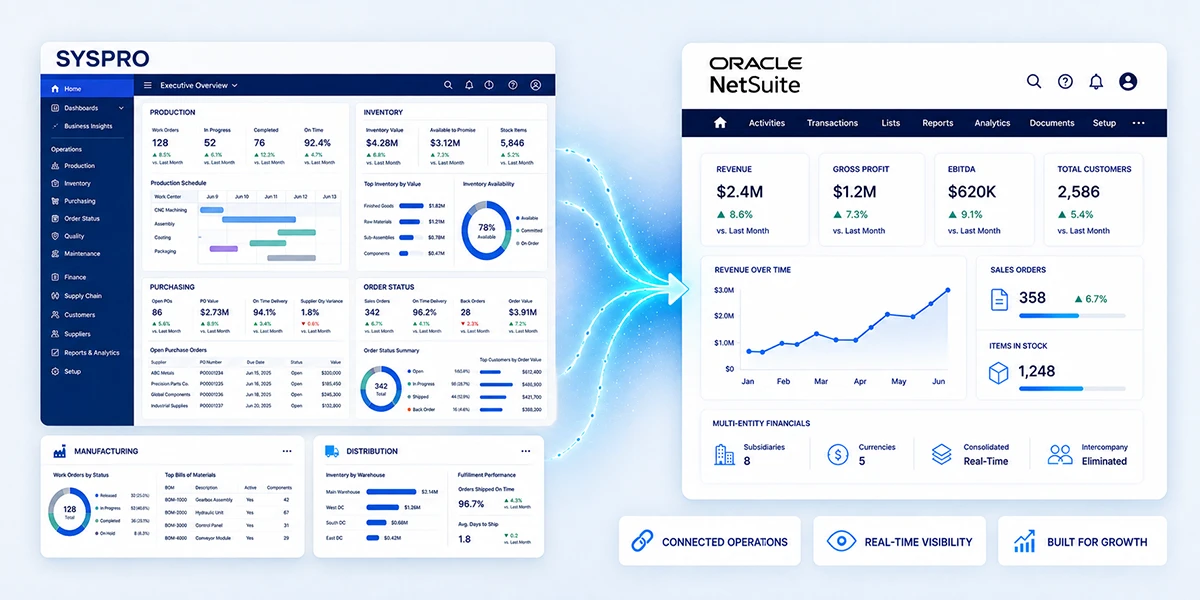
SYSPRO vers NetSuite
Quand l'entreprise change, la décision concernant l'ERP peut changer
Votre entreprise s'est développée
Établir des rapports demande trop de travail
Vos systèmes se multiplient
Un investissement majeur approche
NetSuite a la confiance de 44 000 clients mondiaux























Une plateforme pour l'avenir
Opérations unifiées
Visibilité multi-entité
Fondation ERP Cloud
Éloignez-vous de l'infrastructure ERP gérée par le client et de la planification des mises à niveau dépendantes des versions.
Croissance adaptable
Ajoutez des modules, des utilisateurs, des entités, des flux de travail, des intégrations et de nouvelles fonctionnalités métier à mesure que les exigences évoluent.
Un chemin contrôlé vers NetSuite
1
Évaluation des exigences et de l'adéquation
2
Portée et état de préparation de la migration
3
Mise en œuvre et configuration
4
Mise en service et support continu

“ Les rapports qui prenaient autrefois jusqu'à 5 heures peuvent désormais être générés en quelques minutes. NetSuite a complètement transformé la façon dont nous gérons nos données financières. ”
Yuti Sankhe, Global Supply Solutions, LLC.
SYSPRO vs Oracle NetSuite – Comparaison des plateformes
| Zone | SYSPRO | NetSuite |
| Adéquation métier | Conçu spécifiquement pour la fabrication et la distribution. | PGI cloud unifié soutenant la croissance financière et opérationnelle. |
| Opérations | Solides capacités de fabrication, de gestion des stocks et de distribution. | Relie la fabrication, les stocks, les commandes, les finances, le CRM et le reporting. |
| Stratégie cloud | Les options de déploiement dépendent de l'environnement SYSPRO existant. | ERP cloud multilocataire avec mises à jour de plateforme gérées. |
| Croissance et visibilité | Prend en charge les opérations multi-sociétés en fonction de la configuration et des besoins. | Prend en charge les filiales, les devises, la consolidation et la visibilité globale grâce à NetSuite OneWorld. |
| Coût total de possession | Prenez en compte les logiciels, l'hébergement, les mises à niveau, les intégrations, le support et l'administration. | Considérez l'abonnement, les utilisateurs, les modules, la mise en œuvre, les intégrations et le support continu. |
Sources : Documentation officielle des produits Oracle NetSuite (netsuite.com) ; documentation officielle des produits SYSPRO (syspro.com, us.syspro.com) ; recherche indépendante sur les ERP (erpresearch.com). Cette comparaison est fournie à titre d'information uniquement et ne constitue pas une évaluation fonctionnelle formelle. Les capacités et les caractéristiques des produits sont susceptibles d'être modifiées
Découvrez vos options ERP. Voyez ce qui vous attend avec NetSuite.
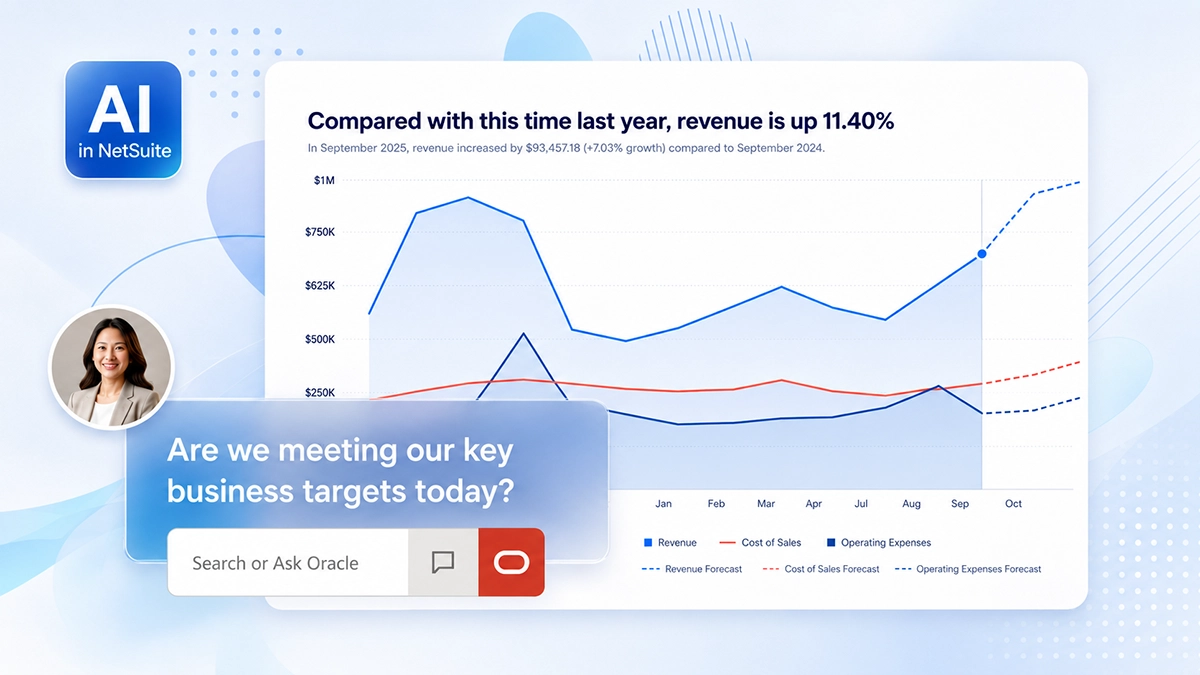
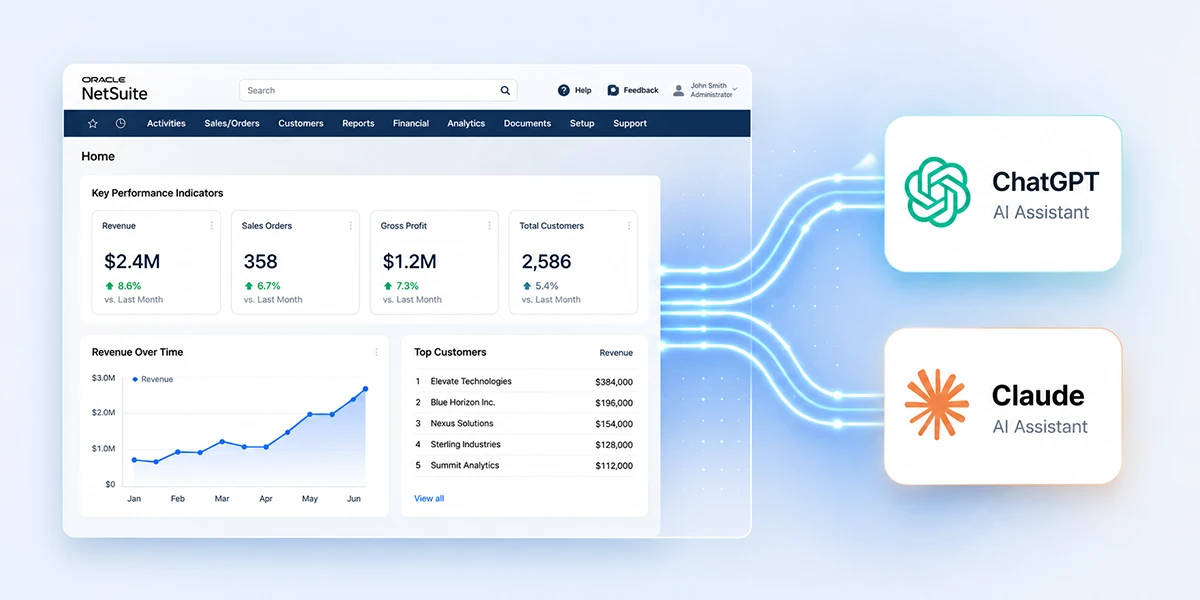
Connecter Claude et ChatGPT à NetSuite
Travaillez avec de vrais experts

FAQ
Est-ce que NetSuite est une bonne alternative à SYSPRO ?
NetSuite peut constituer une alternative crédible pour les fabricants et les distributeurs qui souhaitent connecter la comptabilité, les stocks, les commandes, la chaîne d'approvisionnement, le CRM, le commerce électronique, la gestion multi-entités et le reporting sur une plateforme cloud unifiée. La décision doit néanmoins reposer sur des exigences détaillées en matière de fabrication et d'opérations.
Les données peuvent-elles être migrées de SYSPRO vers NetSuite ?
Est-ce que NetSuite prend en charge la fabrication ?
NetSuite offre des fonctionnalités de fabrication comprenant des ordres de fabrication, des nomenclatures, des gammes, de la planification, des stocks, des achats, du calcul des coûts et la gestion de la chaîne d'approvisionnement. Les entreprises ayant des exigences de production très spécialisées devraient réaliser une évaluation détaillée de l'adéquation fonctionnelle.
Devons-nous mettre à niveau SYSPRO ou passer à NetSuite ?
Cela dépend de l'adéquation au secteur, de la stratégie de déploiement, des personnalisations, des intégrations, des exigences en matière de reporting, des plans de croissance, des ressources internes et du coût total de possession (TCO). Une mise à niveau peut être le bon choix, mais elle doit être comparée à un remplacement avant qu'un autre investissement majeur ne soit approuvé.
Combien de temps prend une mise en œuvre de SYSPRO vers NetSuite ?
Le calendrier dépend des entités, des emplacements, de la complexité de fabrication, du volume de données, des intégrations, des personnalisations, des tests et de la maturité de l'organisation. ERP Success Partners ne devrait fournir un calendrier qu'après avoir terminé la phase de découverte et de cadrage de la migration.
Devons-nous migrer tout notre historique SYSPRO ?
Pas nécessairement. Certaines organisations transfèrent les transactions en cours, les enregistrements maîtres, les soldes et un historique sélectionné tout en conservant une archive pour les enregistrements plus anciens. La bonne approche dépend des exigences en matière de reporting, d'audit, de réglementation et d'exploitation.
Comment faut-il comparer le COT ?
Comparez plus que les coûts de licence ou d'abonnement. Incluez la mise en œuvre, l'infrastructure, l'hébergement, les modules, les utilisateurs, les mises à niveau, les intégrations, les personnalisations, le support, l'administration interne, la formation et l'optimisation continue.