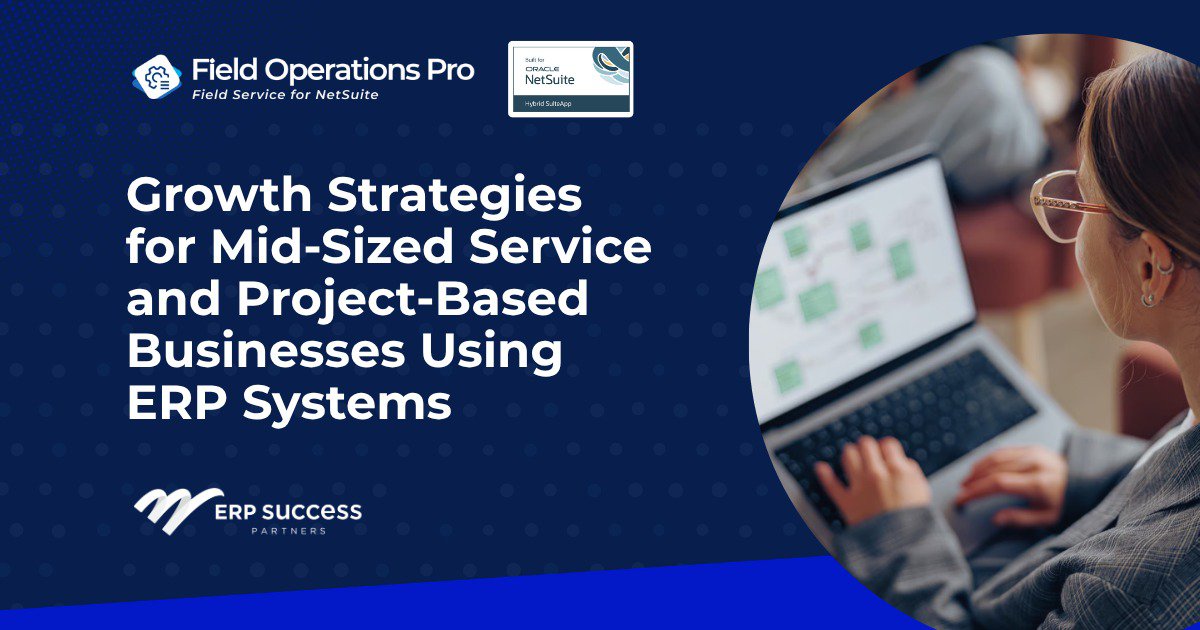
Mid-sized service and project-based businesses occupy a tricky position. They're too large for spreadsheets and manual tracking, but not yet resourced like enterprise organizations. Growth strategies for scaling require more than just adding headcount. It demands smarter systems, cleaner records, and tighter coordination across every department.
ERP (Enterprise Resource Planning) systems have become a core part of how growing companies tackle this challenge. When implemented well, they eliminate the friction that slows work down. They create the infrastructure needed to expand with confidence.
Why Mid-Sized Service Businesses Hit a Growth Ceiling
Stalling rarely happens because of a lack of demand. More often, it stems from internal constraints that quietly erode capacity. Common bottlenecks include:
- Disconnected tools that don't communicate with each other
- Manual processes that consume hours of staff time each week
- No clear insight into project profitability and true costs
- Reactive decision-making caused by delayed or incomplete reporting
These are not isolated problems. They compound over time. A missed change order chips away at the bottom line. A scheduling gap leads to a missed client delivery. Fragmented data means leadership is always working from yesterday's numbers, not today's.
Mid-sized companies often reach a point where adding more people doesn't fix the problem. The issue is the system, not the staff.

Core Growth Strategies for Project-Based Operations
Sustainable scaling starts with a few foundational approaches. These growth strategies don't require a complete organizational overhaul. They focus on removing friction from the workflows that matter most.
Centralizing operations is the first priority. A single source of truth connects finance, project management, and field teams. Decisions become faster and more accurate. People stop chasing information and start acting on it.
Automating repeatable tasks is equally important. Purchase approvals, invoicing, and order routing follow predictable patterns. Automation cuts down on errors and frees up skilled employees for higher-value work.
Standardizing project delivery is the third pillar. Firms that define repeatable templates and milestone tracking finish engagements with fewer surprises. Consistency at this stage translates directly into stronger margins.
Real-Time Visibility as a Competitive Advantage
One of the most underrated strengths of modern ERP solutions is access to live performance data. Most of these organizations run on reports that are hours, days, or even weeks behind. That lag creates critical blind spots.
When leadership can view current project status, inventory levels, and financial performance in a single dashboard, they make sharper decisions. A profitability issue gets flagged before it becomes a significant loss. A workflow bottleneck is spotted before it disrupts a client timeline.
This kind of visibility is not just a tactical asset. It's a strategic one. Leaders who act on current intelligence consistently outmaneuver competitors still waiting on their next weekly summary.
Field crews benefit as well. When technicians and project managers access accurate schedules and updated work orders remotely, coordination tightens. Fewer calls to the office. Fewer missed steps. Faster project turnaround.
How ERP Systems Support Scalable Growth Strategies
Scaling a service-based business means absorbing more volume without a proportional rise in overhead. ERP platforms are designed to support exactly that.
As an organization grows, its systems need to keep pace. Adding a new client shouldn't require three additional administrative hires. A well-configured ERP absorbs the increased workload at the platform layer, not through extra headcount. That's where true efficiency gains are found.
ERP Success Partners works exclusively with NetSuite to help organizations achieve this kind of scalable efficiency. As NetSuite Partner of the Year 2025, their team brings deep industry expertise to every engagement. They specialize in environments where projects, field operations, and complex workflows all intersect.
For contract furniture companies specifically, ERP Success Partners developed CFI Suite, a NetSuite-native solution purpose-built for that sector's unique requirements. It covers project tracking, change order management, manufacturer integration, and warehouse operations. CFI Suite carries Built-for-NetSuite certification, making it one of the few industry-specific solutions to earn that distinction.
Turning Growth Strategies Into Action
Understanding the right approach is only part of the equation. Real value comes from putting that knowledge into practice. Companies that invest in the right ERP infrastructure can take on more clients and deliver more reliably. Protecting margins becomes far more achievable as well.
If your business is bridging the gap between manual processes and enterprise-level capability, now is the time to evaluate your options. Reach out to a specialist at ERP Success Partners to explore what scalable, sustainable growth looks like for your specific industry.